
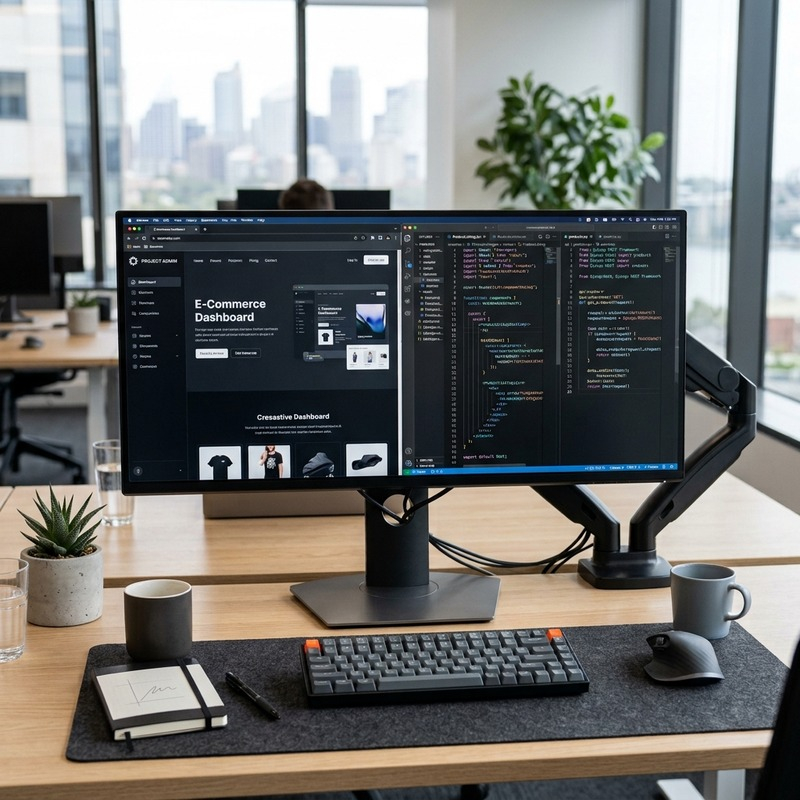
If you're scoping a website or web app and someone's asked whether you need a front-end or a full-stack developer, it's easy to feel lost in the jargon. The distinction matters, though, because it affects what your project can do and how it's built. At Nifty Websites Australia, we provide full-stack web development for businesses across Australia, and this plain-English guide explains the difference between front-end and full-stack developers, when each is enough, and how to work out which your particular project actually needs, so you can brief the build with confidence.
Front-end, back-end and full-stack
These terms sound technical, but the idea behind them is simple.
The front-end is everything users see and interact with in their browser: the layout, design, buttons, forms and animations, the visible face of a website. A front-end developer builds that experience, making sure the site looks right and responds as people click and scroll. The back-end is everything behind the scenes users don't see: the servers, databases and logic that store information, process actions and make things happen, like saving an order or checking a login. A full-stack developer works across both, handling the visible front-end and the hidden back-end together.
Think of a website like a restaurant: the front-end is the dining room the guests experience, the back-end is the kitchen where the real work happens, and a full-stack developer can work in both. Our front-end and back-end guide explains this in more detail if you'd like to go deeper.
When is a front-end developer enough?
A front-end developer is often all you need, and knowing when helps you avoid over-scoping your project.
If you're building a relatively simple marketing website that presents your services, tells your story and lets people get in touch, much of the work is front-end: design, layout and user experience. Customising an existing template to your brand is largely front-end work too, as are visual and interface tweaks like refreshing the look, adjusting layouts or improving how pages respond on different devices. In these cases, the site doesn't need complex custom logic or deep integrations, so front-end skills, often with a CMS like WordPress handling the back-end, are enough to deliver an excellent result.
The key sign is that your project is mainly about how the site looks and presents information, not custom functionality or data-heavy features.
When do you need full-stack?
You move into full-stack territory once your project needs to do things behind the scenes, not just present information.
Custom functionality is the clearest sign: features built specifically for your business, since that logic lives in the back-end. Logins and user accounts require full-stack work, because storing users securely and managing what they can access happens server-side. Anything database-driven, where the site stores and manages significant information, needs the back-end built properly. Integrations are another trigger, connecting your site to systems like a CRM, payment gateway or booking tool, which requires back-end development. And eCommerce logic beyond a simple store, like custom pricing or complex workflows, calls for full-stack capability.
In short, whenever your project involves custom features, data, accounts or connections to other systems, you need full-stack capability.
How does this affect cost and timeline?
The developer your project needs affects both cost and timeline, though the relationship is straightforward.
A front-end-only project, like a marketing site or template customisation, is generally quicker and cheaper, with less to build and fewer moving parts to test. A full-stack project involves more work, since building the back-end, databases, custom functionality and integrations takes additional time and expertise, which is reflected in both the timeline and the cost.
That's not a reason to avoid full-stack when you need it; more capability simply means more to build. The important thing is to match the developer to the project, so you're not paying for full-stack complexity on a simple site, nor forcing a front-end-only approach onto a project that needs back-end development. We won't quote figures here, since it depends on your scope, but the right fit keeps your project capable and cost-effective.
What questions should you ask before you hire?
Before you engage a developer, a few clear questions help you get the right fit and avoid surprises.
Start with scope: be clear about what your project actually needs to do, both the visible experience and any behind-the-scenes functionality, because that determines whether you need front-end or full-stack skills. Ask specifically about integrations, whether the project needs to connect to any other systems now or in the future, since that's a strong indicator of full-stack requirements and is easy to overlook early on. And ask about ongoing support, because a website, especially one with custom functionality or integrations, needs maintenance over time, so know who handles that. It's also worth asking whether the team can handle both front-end and back-end if your needs grow.
Asking these up front means you brief accurately and choose a developer suited to the project, rather than discovering a mismatch mid-build.
Final thoughts
Choosing between a front-end and a full-stack developer comes down to what your project needs to do. If it's mainly about how the site looks and presents information, front-end skills are often enough; if it needs custom functionality, accounts, a database or integrations, you'll want full-stack capability. Match the developer to the project and you get exactly what you need without overpaying.
To scope your build with an experienced team, explore our full stack web developer service.
Scope your build with the right developer
Talk to Nifty Websites Australia. Call 1300 164 389 or request a quote.